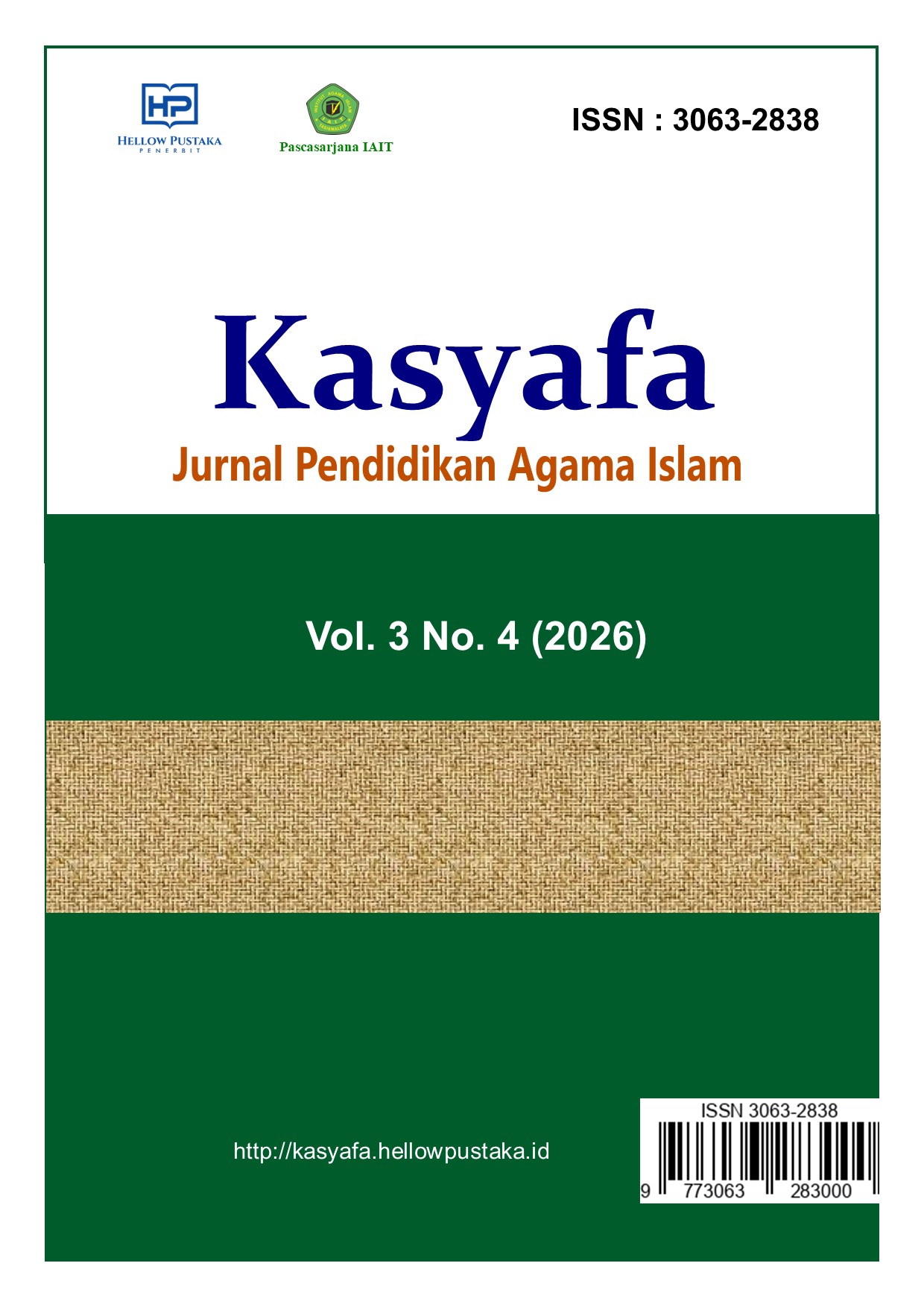
Influence of Civic Education on the Prevention of Social Media Misinformation among Secondary School Students in Gusau Local Government Area, Zamfara State
DOI:
https://doi.org/10.61166/kasyafa.v3i4.174Keywords:
Civic Education, Critical Thinking, Digital Citizenship, Misinformation, Social MediaAbstract
The proliferation of social media has transformed information access and communication among young people, but it has also increased exposure to misinformation and fake news. This study examined the influence of Civic Education on the prevention of social media misinformation among secondary school students in Gusau Local Government Area, Zamfara State. Specifically, the study investigated the influence of Civic Education on students' ability to identify social media misinformation, critically evaluate information obtained from social media platforms, and engage in responsible social media usage to prevent the spread of misinformation. The study adopted a descriptive survey research design. The population comprised senior secondary school students in public secondary schools in Gusau Local Government Area, while a sample size of 384 respondents was selected using multistage sampling techniques. Data were collected through a structured questionnaire validated by experts and tested for reliability. Simple Linear Regression Analysis was employed to test the hypotheses at a 0.05 level of significance. The findings revealed that Civic Education significantly influences students' ability to identify social media misinformation (β = 0.492, p < 0.05), critically evaluate information obtained from social media platforms (β = 0.564, p < 0.05), and engage in responsible social media usage for preventing misinformation (β = 0.601, p < 0.05). The study concluded that Civic Education plays a vital role in promoting media literacy, critical thinking, and responsible digital citizenship among students. It was recommended that media literacy, digital citizenship, and misinformation awareness be further integrated into Civic Education programmes in secondary schools.
References
Alluhidan, A., Akter, M., Alsoubai, A., Park, J., & Wisniewski, P. (2024). Teen talk: The good, the bad, and the neutral of adolescent social media use. arXiv. https://doi.org/10.48550/arXiv.2409.02358
Asogwa, U. D., Bisong, A. E., Imoke, E. N., et al. (2024). Effect of digital storytelling on secondary school students’ self-efficacy in Civic Education. Journal of Educational Technology and Innovation, 12(2), 45–61.
Bolante, K., Chen, K., Chen, Q. Z., & Zhang, A. (2024). Bringing social computing to secondary school classrooms. arXiv. https://doi.org/10.48550/arXiv.2401.09591
Council of Europe. (2024). Digital citizenship education handbook. Council of Europe Publishing.
European Commission. (2024). Guidelines for teachers and educators on tackling disinformation and promoting digital literacy through education and training. Publications Office of the European Union.
García-Marín, D., et al. (2025). Media literacy education and misinformation in social media among adolescents: A systematic review and meta-analysis. Youth, 7(2), 71–89.
Howard, P. N., Neudert, L. M., Prakash, N., & George, A. (2024). Information integrity and misinformation in the digital age. International Panel on the Information Environment.
International Panel on the Information Environment. (2024). Global survey on misinformation and information integrity in the digital environment. IPIE.
Jones-Jang, S. M., Mortensen, T., & Liu, J. (2021). Does media literacy help identification of fake news? Information literacy helps, but other literacies do not. American Behavioral Scientist, 65(2), 371–388.
Kukreja, D., & Rajendran, M. (2024). Digital citizenship, internet attitudes and computer self-efficacy: Mapping factors influencing middle school students’ online participation. Indian Journal of Educational Technology, 6(2), 127–144.
McGrew, S. (2024). Teaching students to evaluate online information: Advances in civic online reasoning research. Journal of Media Literacy Education, 16(1), 1–15.
Mihailidis, P. (2022). Civic media literacies in a post-truth era: Preparing young citizens for democratic participation. Journal of Media Literacy Education, 14(2), 1–12.
OECD. (2023). PISA 2022 results: Creative minds, creative schools and digital engagement. OECD Publishing.
Qian, S., Shen, C., Wang, H., & Cho, H. (2026). Building resilience to misinformation: A cross-national development of the Digital Media and Information Literacy Scale (DMILS). arXiv. https://arxiv.org/abs/2605.17676
Reuters. (2023). Nigeria's social media fact-checkers fight fake news as vote nears. Reuters.
Selnes, F. N. (2024). Adolescents’ experiences and (re)action towards fake news on social media: Perspectives from Norway. Humanities and Social Sciences Communications, 11, Article 1694.
Senos, S., João, G., Loureiro, M. J., Torres, J., & Rosário, R. M. (2024). Digital citizenship in secondary education: The project “The Internet as We See It.” Educational Media International, 61(4), 368–382. https://doi.org/10.1080/09523987.2024.2436739
Siani, A., Joseph, M., & Dacin, C. (2024). Susceptibility to scientific misinformation and perception of news source reliability in secondary school students. Discover Education, 3, Article 93.
The Guardian Foundation. (2024). News and media literacy in the curriculum: Building informed citizens. The Guardian Foundation.
UNESCO. (2023). Media and information literacy curriculum for educators and learners. UNESCO.
UNESCO. (2024). Empowering youth to combat misinformation through media and information literacy. UNESCO.
UNESCO. (2024). Media and information literacy: Think critically, click wisely. UNESCO.
UNESCO. (2024). Q&A: Why digital global citizenship education is essential. UNESCO.
UNICEF. (2023). Digital citizenship and online safety for children and adolescents. UNICEF.
Wineburg, S., & Breakstone, J. (2023). Verified: How to think straight, get duped less, and make better decisions about what to believe online. University of Chicago Press.
Zainudin, J., Ali, N. M., Smeaton, A. F., & Ijab, M. T. (2024). Intervention strategies for misinformation sharing on social media: A bibliometric analysis. arXiv. https://doi.org/10.48550/arXiv.2409.17637
Downloads
Published
How to Cite
Issue
Section
License
Copyright (c) 2026 Sule Muhammad

This work is licensed under a Creative Commons Attribution 4.0 International License.