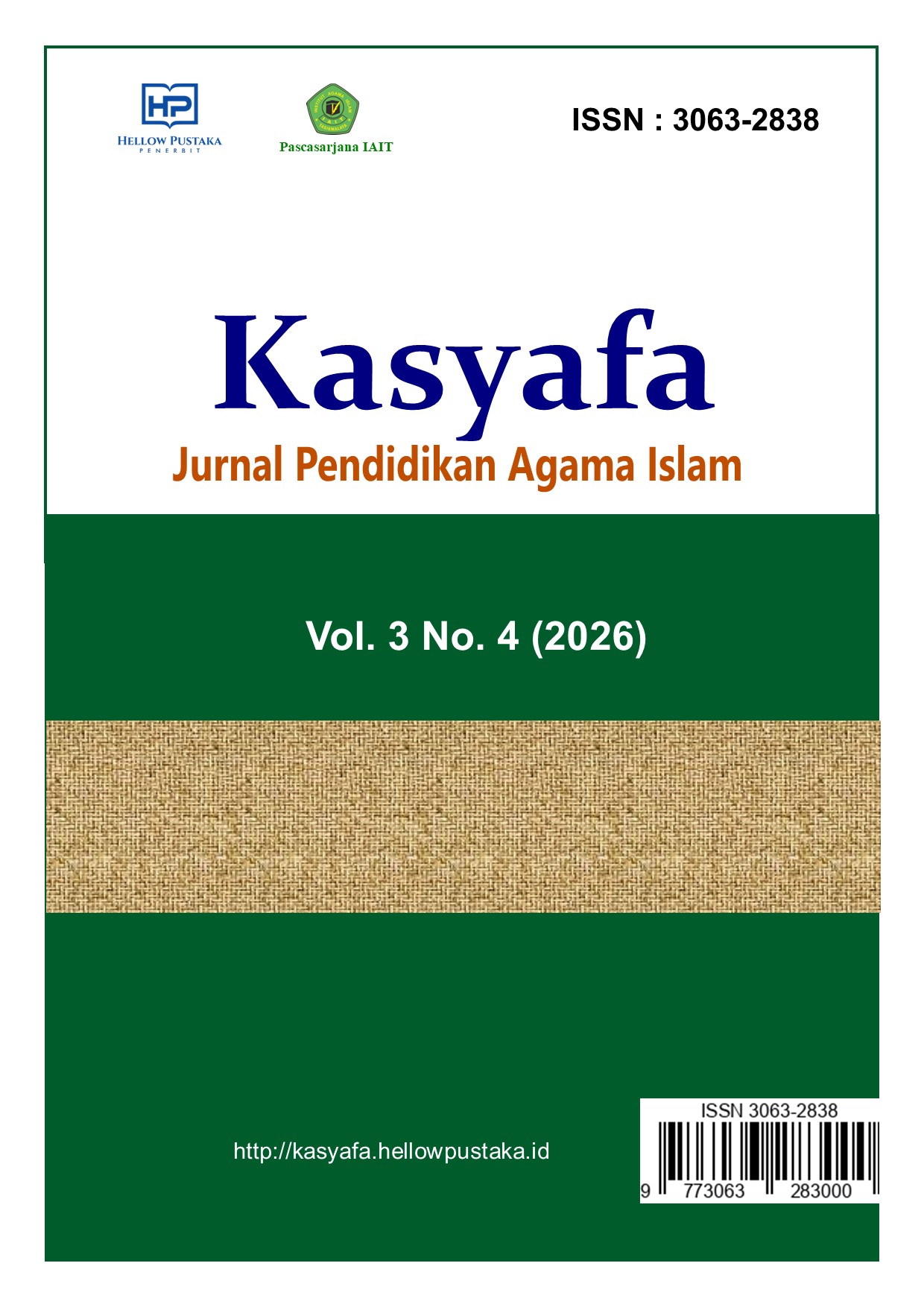
Islamic Eco-theology in the Era of Generative AI: Reconstructing Islamic Religious Education to Foster Ecological Consciousness
DOI:
https://doi.org/10.61166/kasyafa.v3i4.181Keywords:
Islamic Eco-theology, Generative AI, Islamic Religious Education, Ecological Awareness, Reconstruction of Learning.Abstract
The environmental crisis requires the learning of Islamic Religious Education (PAI) to be not only oriented towards the mastery of religious knowledge, but also on the formation of students' ecological awareness and responsibility. In the context of the development of Generative Artificial Intelligence (GenAI), this technology opens up opportunities to reconstruct PAI learning through the presentation of contextual, interactive, and reflective Islamic ecotheology materials. This research aims to analyze the integration of Islamic ecotheology and GenAI in the reconstruction of PAI learning to form students' ecological awareness. The research uses a qualitative approach through a literature study with thematic analysis of relevant literature on Islamic ecotheology, environmental education, and the use of GenAI in learning. The results of the study are directed at the formulation of an ecotheology-based PAI learning model that integrates the values of the caliph of philanthropy, trust, and responsibility to protect the environment through the stages of knowledge exploration, reflection of Islamic values, critical dialogue assisted by GenAI, and real ecological action. The novelty of this study lies in the integration of theological, pedagogical, and generative technology dimensions in a learning framework that is oriented towards the transformation of consciousness into ecological behavior. Nevertheless, the use of GenAI needs to be accompanied by teacher assistance, verification of Islamic sources, and critical evaluation of the information produced. This study is expected to make a conceptual contribution to the development of PAI learning that is adaptive to technological developments while being oriented towards environmental conservation.
References
Almasri, F. (2024). Exploring the impact of artificial intelligence in teaching and learning of science: A systematic review of empirical research. Research in Science Education, 54, 977–997. https://doi.org/10.1007/s11165-024-10176-3
Azhari, H., dkk. (2025). The role of green Islamic education in developing eco-theological consciousness among emerging Muslim generations. EDUKASI: Jurnal Penelitian Pendidikan Agama dan Keagamaan, 23(3), 531–542. https://doi.org/10.32729/edukasi.v23i3.2374
Chauhan, R., Prasad, M., Taherdoost, H., & Unhelkar, B. (Eds.). (2027). Integrating AI-enabled computing strategies into sustainable development. Elsevier.
Farida, I., dkk. (2017). Project-based teaching and learning design for internalization of environmental literacy with Islamic values. Jurnal Pendidikan IPA Indonesia, 6(2), 277–284. https://doi.org/10.15294/jpii.v6i2.9452
Kadi, T., & Tamam, B. (2025). Fostering ecological awareness: The role of ecotheology-based Islamic education in higher education. EDURELIGIA: Jurnal Pendidikan Agama Islam, 9(3). https://doi.org/10.33650/edureligia.v9i3.12125
Kasneci, E., dkk. (2023). ChatGPT for good? On opportunities and challenges of large language models for education. Learning and Individual Differences, 103, Article 102274. https://doi.org/10.1016/j.lindif.2023.102274
Kumaidin, A., & Hadi, S. (2026). Islam dan ekopedagogi: Gagasan pengembangan kurikulum PAI berbasis kesadaran lingkungan. Almarhalah: Jurnal Pendidikan Islam, 10(1), 36–47. https://doi.org/10.38153/4yjha720
Leal Filho, W., Kim, E., Borsatto, J. M. L. S., et al. (2025). Using artificial intelligence in sustainability teaching and learning. Environmental Sciences Europe, 37, Article 124. https://doi.org/10.1186/s12302-025-01159-w
Lutfauziah, A., dkk. (2023). Curriculum development for environmental education at an Islamic boarding school. Journal of Turkish Science Education, 20(3), 490–503. https://doi.org/10.36681/tused.2023.028
Marzano, D. (2026). Generative artificial intelligence (GAI) in teaching and learning processes at the K-12 level: A systematic review. Technology, Knowledge and Learning, 31, 789–829.
Nabilah, H. I., dkk. (2026). Perspektif ekoteologi dalam pembelajaran PAI terhadap pembentukan kesadaran ekologis. Pendas: Jurnal Ilmiah Pendidikan Dasar, 11(3). https://doi.org/10.23969/jp.v11i03.57616
Qamariah, S., Ilyasin, M., & Bahrani, B. (2025). Integrating ecotheology into Islamic education: A multicultural perspective study among kindergarten students. Dinamika Ilmu, 25(2), 245–263.
Qian, Y. (2025). Pedagogical applications of generative AI in higher education: A systematic review of the field. TechTrends, 69, 1105–1120. https://doi.org/10.1007/s11528-025-01100-1
Rahman, N. A., dkk. (2020). Integration of tauhidic elements for environmental education from the teachers’ perspectives. Religions, 11(8), Article 394. https://doi.org/10.3390/rel11080394
Rahmat, H. K., & Affandi, A. (2025). Penggunaan bahan ajar Pendidikan Agama Islam berwawasan lingkungan dalam menumbuhkan literasi ekologi pada siswa sekolah menengah pertama. Al-Isyraq: Jurnal Bimbingan, Penyuluhan, dan Konseling Islam, 8(2). https://doi.org/10.59027/alisyraq.v8i2.1001
Rohman, A., Kurniawan, E., Syifauddin, M., Muhtamiroh, S., & Muthohar, A. (2024). Religious education for the environment: Integrating eco-theology in the curriculum of Islamic religious and character education to enhance environmental education in Indonesia. Nadwa: Jurnal Pendidikan Islam, 18(2), 201–226.
Saputra, S. E., dkk. (2026). Advancing eco-theology in Islamic educational framework: A systematic review of Indonesian research landscape. Edusoshum: Journal of Islamic Education and Social Humanities, 6(1), 678–692. https://doi.org/10.52366/edusoshum.v6i1.351
Taufikin, T., & Yusdani, Y. (2025). Ecological literacy in Islamic education: Strengthening environmental awareness through tauhid-based learning. Madania: Jurnal Kajian Keislaman, 29(1). https://ejournal.uinfasbengkulu.ac.id/index.php/madania/article/view/7741
Taufikin. (2025). Integrating eco-theology in Islamic education: A case study on fostering ecological awareness through religious pedagogy. el-Tarbawi, 18(1), 1–32
Tlili, A., dkk. (2023). What if the devil is my guardian angel: ChatGPT as a case study of using chatbots in education. Smart Learning Environments, 10, Article 15. https://doi.org/10.1186/s40561-023-00237-x
Ventura, R. B., Saril, M. J., Nasikin, M., Martasila, D. S., & Khasanah, U. (2026). Integration of ecotheological values in the Islamic education curriculum in the era of ecological crisis. At Turots: Jurnal Pendidikan Islam.
Yusuf, A., dkk. (2024). Generative AI in education and research: A systematic mapping review. Review of Education, 12(2), Article e3489. https://doi.org/10.1002/rev3.3489
Zhang, X., dkk. (2024). A systematic literature review of empirical research on applying generative artificial intelligence in education. Frontiers of Digital Education, 1(3), 223–245. https://doi.org/10.1007/s44366-024-0028-5
Downloads
Published
How to Cite
Issue
Section
License
Copyright (c) 2026 Barerotul Inayah

This work is licensed under a Creative Commons Attribution 4.0 International License.