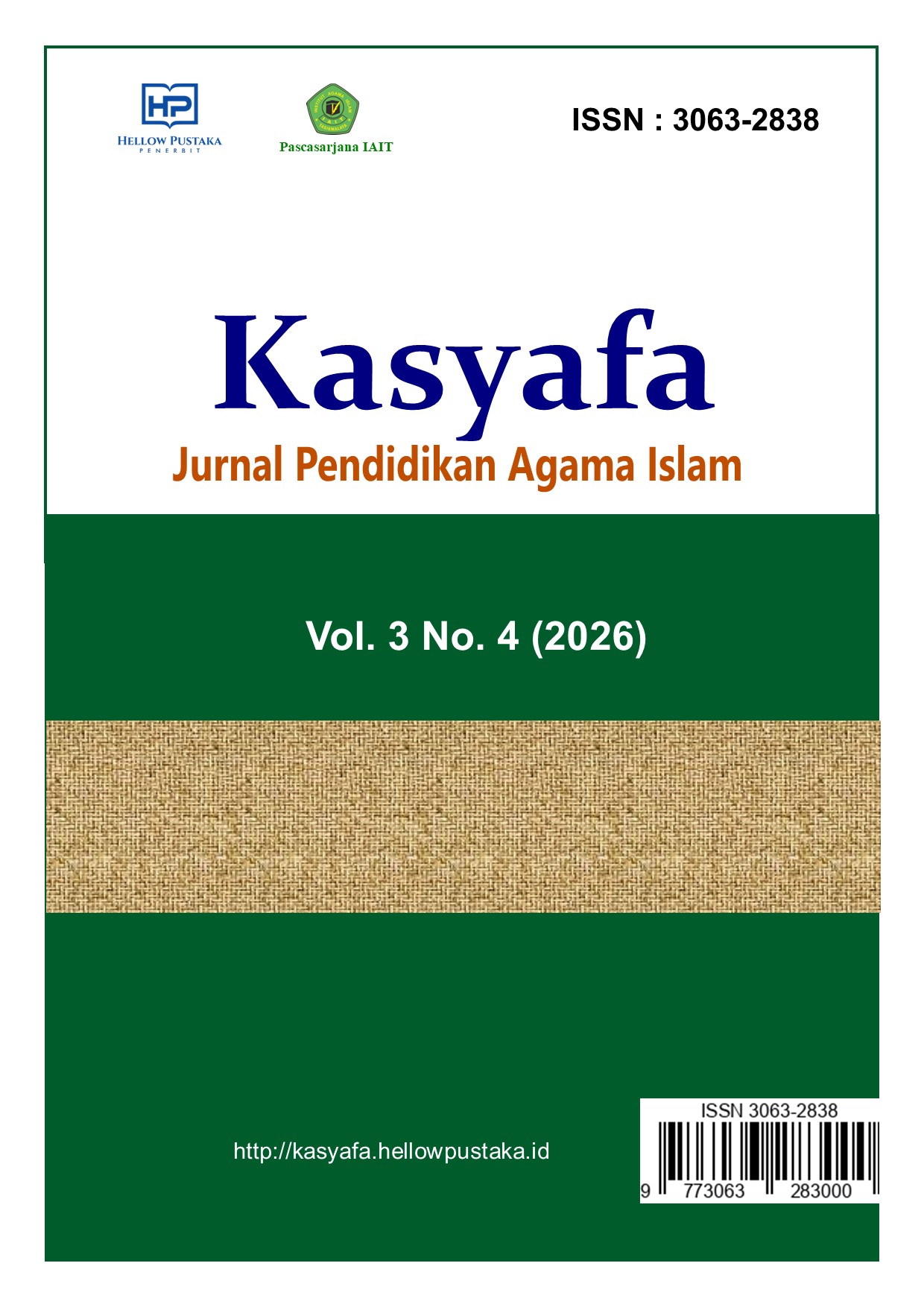
Internalization of the Sundanese Local Wisdom Values—Silih Asah, Silih Asih, Silih Asuh—within Akidah Akhlak (Islamic Creed and Ethics) Instruction to Address the Challenges of the Artificial Intelligence Era at MTs Sabilul Huda Karangasem
DOI:
https://doi.org/10.61166/kasyafa.v3i4.180Keywords:
Value Internalization, Sundanese Local Wisdom, Silih Asah, Silih Asih, Silih Asuh, Aqidah Akhlaq, Artificial Intelligence.Abstract
The development of artificial intelligence (AI), particularly generative AI, has transformed how students access information, interact, and construct knowledge. Although AI offers opportunities for adaptive and interactive learning, it also raises concerns regarding technological dependence, inadequate information verification, plagiarism, diminished independent thinking, and moral integrity. This study aims to examine the internalization of Sundanese local wisdom values—silih asah, silih asih, and silih asuh—in Aqidah Akhlaq learning as a foundation for developing ethical AI use among students at MTs Sabilul Huda Karangasem. The study is designed as a qualitative case study. Data are to be collected through classroom observations, in-depth interviews with the headmaster, Aqidah Akhlaq teachers, and students, as well as documentation of instructional materials and technology-use policies. Data analysis involves data condensation, data display, thematic coding, and conclusion verification through source and method triangulation. The literature synthesis indicates that silih asah supports AI literacy, critical thinking, and information verification; silih asih promotes empathy, respect for human dignity, and the prevention of technological misuse; while silih asuh strengthens responsibility, guidance, role modelling, and ethical supervision. These values can be integrated with Islamic principles such as ṣidq (truthfulness), amānah (trustworthiness), tabayyun (verification), and responsibility in seeking knowledge. However, the extent of their internalization and effectiveness at MTs Sabilul Huda Karangasem requires empirical verification. This study proposes a local-wisdom-based character education framework to develop students who can use AI competently without losing intellectual independence and moral responsibility.
References
Amin, M. (2026). Ethical use of generative artificial intelligence in Islamic Religious Education: Perspectives of Madrasah Aliyah teachers and students in Banjarmasin. Al-Munawwarah: Journal of Islamic Education, 2(2), 147–161. https://doi.org/10.38073/almunawwarah.v2i2.5654
Ansori, Y. Z., Agustin, M., Jatisunda, M. G., & Azman, M. N. A. (2025). Integrating Silih Asah, Silih Asih, and Silih Asuh in primary school character education. Profesi Pendidikan Dasar, 12(3), 321–337. https://doi.org/10.23917/ppd.v12i3.12143
Azizah, R., & Wardefi, R. (2026). Artificial intelligence and academic integrity in Islamic higher education: Exploring ethical challenges among Islamic education students. Al-Adabiyah: Jurnal Pendidikan Agama Islam, 7(4), 625–646. https://doi.org/10.35719/adabiyah.v7i4.1449
Dewi, R., Hanun, F., Hadiana, D., Sylvia, N., Ramdani, Z., et al. (2025). Silih Asah, Silih Asih, and Silih Asuh (SILAS): A decolonial conceptual framework for relational early childhood education in the Sundanese context amid global childhood discourses. Journal of Early Childhood Research. https://doi.org/10.1177/20436106251398516
Handarini, S., & Herlambang, Y. T. (2025). Silih Asah, Silih Asih, and Silih Asuh values in developing elementary school students' social ethics: A systematic literature review. Sosioedukasi: Jurnal Ilmiah Ilmu Pendidikan dan Sosial, 15(1). https://doi.org/10.36526/sosioedukasi.v15i1.7064
Hasanah, U., Khairunnisa, R., Della, D. A., & Attamimi, T. A. (2024). Opportunities, challenges and ethics of artificial intelligence implementation in teaching Islamic Religious Education in public universities: A case study in South Kalimantan. JMPI: Jurnal Manajemen, Pendidikan dan Pemikiran Islam, 2(2), 144–154. https://doi.org/10.71305/jmpi.v2i2.92
Huzaeema, F. T., Nurvadi, G. M., Parameswari, L., Basyari, I. W., & Hayati, A. A. (2024). Sundanese ethnic mentifact culture Silih Asih, Silih Asuh, Silih Asah in the context of ethnopedagogy. International Journal of Humanities Education and Social Sciences, 4(1). https://doi.org/10.55227/ijhess.v4i1.1174
Kementerian Komunikasi dan Digital Republik Indonesia. (2026). Keputusan Menteri Komunikasi dan Digital Nomor 117 Tahun 2026 tentang Pedoman Pemanfaatan dan Pembelajaran Teknologi Digital dan Kecerdasan Artifisial di Jalur Pendidikan Formal, Nonformal, dan Informal.
Kementerian Pendidikan Dasar dan Menengah Republik Indonesia. (2025). Keputusan Menteri Pendidikan Dasar dan Menengah Nomor 127/P/2025 tentang Pedoman Implementasi Koding dan Kecerdasan Artifisial pada Pendidikan Anak Usia Dini, Jenjang Pendidikan Dasar, dan Jenjang Pendidikan Menengah.
Miao, F., & Holmes, W. (2023). Guidance for generative AI in education and research. UNESCO. https://doi.org/10.54675/EWZM9535
Miles, M. B., Huberman, A. M., & Saldaña, J. (2020). Qualitative data analysis: A methods sourcebook (4th ed.). SAGE Publications.
Salim, M. A., & Habibi, F. (2025). AI ChatGPT based Islamic Religious Education to enhance students' critical thinking and moral reasoning. ISLAMIKA, 7(4), 716–729. https://doi.org/10.36088/islamika.v7i4.5915
UNESCO. (2022). Recommendation on the ethics of artificial intelligence. UNESCO. https://www.unesco.org/en/legal-affairs/recommendation-ethics-artificial-intelligence
UNESCO. (2024a). AI competency framework for students. UNESCO.
UNESCO. (2024b). AI competency framework for teachers. UNESCO.
Downloads
Published
How to Cite
Issue
Section
License
Copyright (c) 2026 Tatang Tarmidi

This work is licensed under a Creative Commons Attribution 4.0 International License.